
Where the Window Shade Points
Begin with the line inside the wall
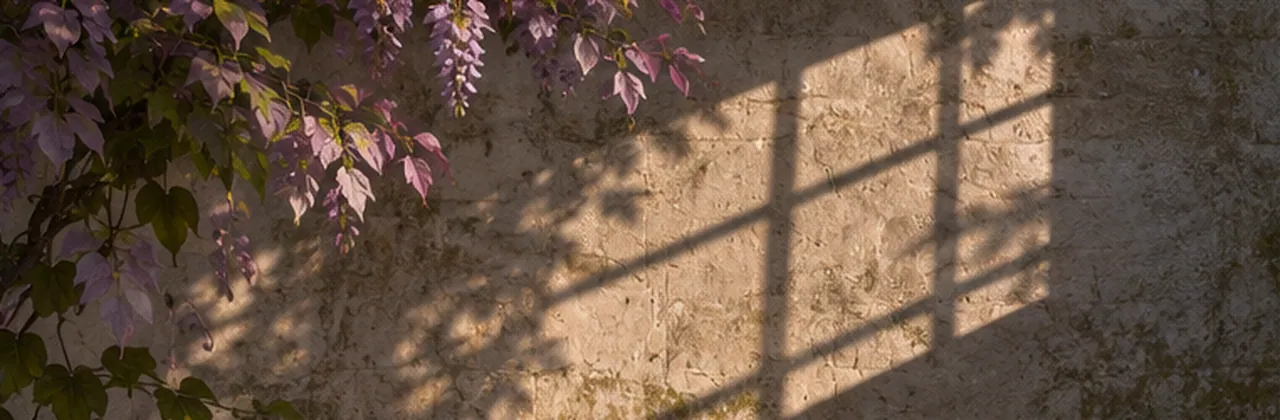
A tall window set in pale limestone admits a narrow slant of light late in the day. The edge of its frame crosses the wall and reaches a piece of paving below it. Another shadow from the arcade travels along the same wall at a gentler angle. While looking from the far side of the arcade, both can appear to belong to the window and suggest a wrong direction toward the innermost edge of the path.
Follow the frame through its narrow section
The first useful part of the shadow is a short dark line that ends near the sill. Walking toward it gives you a clear view of where it meets a different plane of stone. The looser line from the arcade travels farther to the right. On the paving the short line becomes a longer diagonal that stays attached to the opening. Seeing it cross the change of surface provides another clue about its source.
Preserve space between the leaf shadows
A large pattern of broad leaves fills the upper part of the window view. We moved a few marks away from the point where the narrow line first appears. That arrangement reduces overlap at the beginning and retains it farther along, where recognizing the source is already easier. Leave room to see the long angle again after moving to the side of the wall. We use the narrow direction as a short thread connecting those two views.
Take a different reading from lower down
When kneeling near the paving, the lower part of the diagonal seems to end at the base of a post. The connection to the tall window is visible if you bring your eye a little closer to the wall. The Third Shadow Bell passes that point shortly after its second cue and gives time to look again. You can compare which part of the shade changes slowly even when the brighter area near the window moves sharply under the leaves.
Follow the older line while the light shifts
In an earlier iteration a bright outline stayed over the right direction whenever the player reached the bend. That outline removed the need to note where the actual shadow began. The new scene keeps a point in the wall visible and lets the line travel past it. A Walk Between Trellises carries that change to a quieter section of pavement. The route is clearer if the player can match an earlier position from the window to a later position on the ground.
Use the window edge to test two times
The sun reaches the lower edge of the window during one part of the afternoon. It gives a short diagonal along the sill. Later it falls almost parallel to the top edge of the sill and the diagonal seems very faint. Open the wider camera to see both the end of the shade and the frame. From that position there is a visible relation between them even when the framing shadow has stopped pointing towards the expected place.
Hold the corner in a view after the sound
Read the Shade after the Bell asks how much of the previous shadow remains when the scene grows quiet. The window gives a small clue after it loses the broad bright patch. A clean corner below the sill shows where the old angle stopped. Keeping that corner available lets the same shape have a lasting effect after the timing scene has already ended.
Put it beside the route
Arbor Sections groups the window with the turning vine and the first arcade. Follow each of those entries if a shadow direction begins to resemble another family’s shape. Comparing solid surfaces is often more useful than naming the particular shade. We base the next passage on the corner and a small opening across from it, where the frame can still be found from inside the trellis.