
Reading a Double Shadow
Stand where the beam reaches the wall
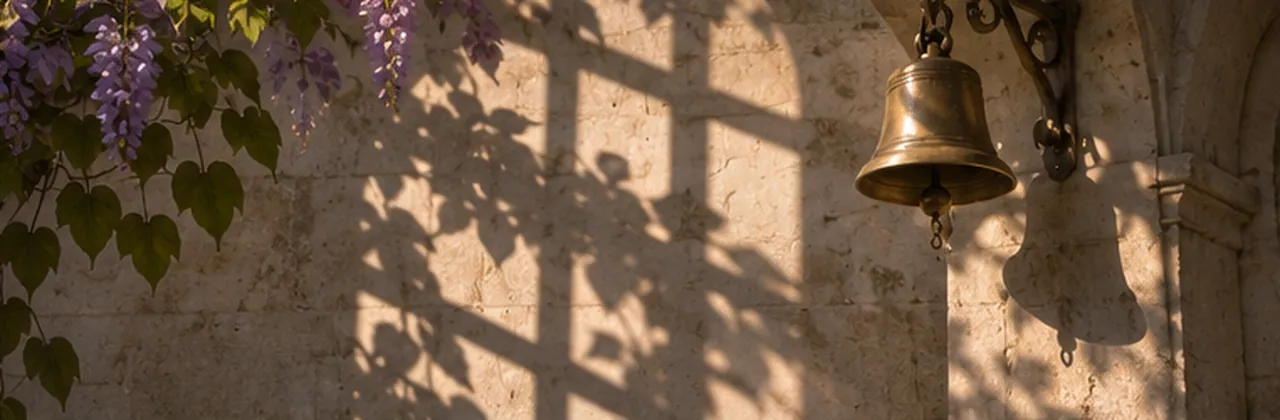
One part of the arcade casts a straight shadow across a pale slab. A loose pattern of leaves crosses it from above. In the first sketch those two areas reached the darkest color of the picture together. The line where they overlap was hard to see, which meant the shade looked like a single wide band. A player waiting for the beam to move past a line in the stone had little evidence of whether the motion belonged to a leaf or the whole beam.
Introduce a quieter layer
We first separated the two shadows by color. The leaves became softer and the beam remained cool and dark. After changing the light to reflect a later hour, the contrast nearly disappeared again. We kept the leaf pattern a little more open at the edge and described its pointed shape with several small patches of light. The beam retained one straight boundary all the way down the wall, including where the two shadows meet.
Let a joint run through the overlap
A horizontal joint in the wall breaks the long shadow for a short distance. Because the line belongs to the wall, it stays in the same place when either shadow moves. The revised study makes the line visible on both sides of the overlap. Start at the joint, then trace each shadow away from it. The player can tell whether a smaller change follows the wide beam or moves back into the leaves.
Try near the edge of the arcade
From below, the line of the beam seems to become almost vertical. It travels out of the frame more quickly than the loose pattern. From the wider view you can see the leaves and the stone that receives them at the same time. The Third Shadow Bell uses the closer view after a person has already seen the beam from the start. The player has another chance to return to the broader frame if the line is ambiguous.
Watch after the first sound
An early scene cut to a new view when the first bell was heard. It took away the chance to watch the loose shadow cross the straight edge. We left the existing view in place a little longer. The sound points forward while a visible change continues in the earlier part of the garden. Anyone who takes a closer look can recognize which movement lasted through the sound before walking toward the next support.
Check how the same problem looks at a corner
A Vine across the Corner has a narrow turning shape instead of a wide pattern of leaves. Its shadow remains recognizable as a curve where it reaches the paving beside a straight rail. The corner shares a piece of the same vine with the arcade. In that study we used a lower stone as a fixed reference. A joint in the wall works here because the player already has a reason to watch the wall while reading the bell.
Find a useful boundary from the other side
Another position along the arcade leaves the loose patch visible at the top but covers the joint. The strong part of the beam shadow appears as a thin edge at the base of the slab. It can be followed up to where the wall becomes bright. If both edges become too thin, the person can circle the post to get an uninterrupted look again. This route gives them enough time to make that check during a later test.
Keep the observation easy to revisit
Light Studies places this image before the article about the turning vine. The two records use different stone details to distinguish shade from its source. Check them together when designing a new overlap lower on the path. A single reference that survives the movement can do more for the scene than another stroke that needs to be interpreted as a new sign.