
A Vine across the Corner
Draw the bend above the route
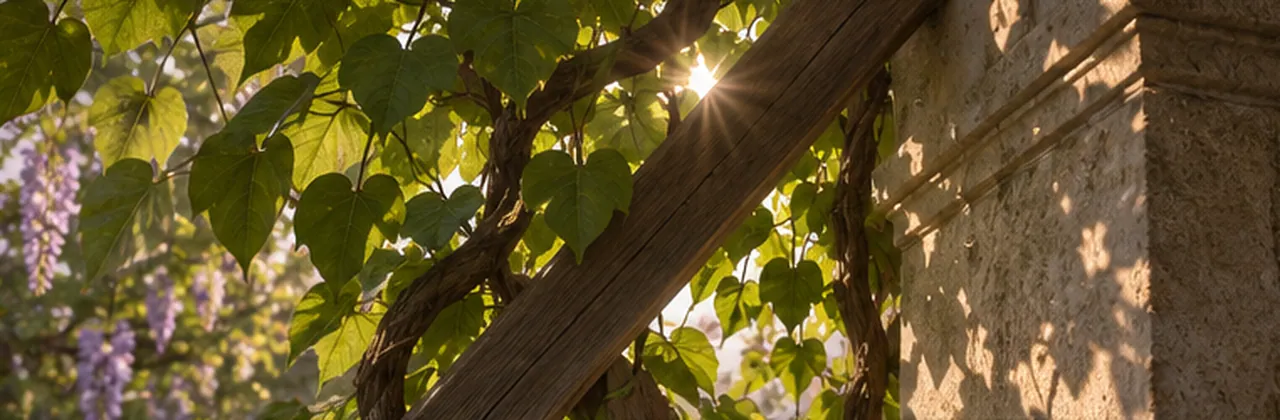
Near the second trellis, a wisteria vine moves diagonally across the top support and then turns toward a post. On the ground that corner appears as a mark that starts narrow and thickens. In the first prototype the shadow formed a clean line with a sharper diagonal from the second trellis. A walker near the middle could read the two marks as a continuation. Both the route and the apparent source were difficult to locate from that position.
Look for the curve near the post
The latest study leaves a short undulating end below the place where the vine goes around the support. The straight shadow still comes in from the side. At the closest corner, a person can place the bent shadow beside a stone at the base of the post. When they step down onto the gravel, the dark line from the second trellis passes in front of that stone and changes direction in the view.
Put the leaves above the first anchor
An earlier leaf cluster seemed to end immediately before the turn of the vine. We raised it slightly and let a few leaves remain on the inner side of the curve. Looking toward the sun, those leaves make a familiar shape after the rest of the vine becomes difficult to see. The player can compare one part of the plant to the bent shape on the path without needing an uninterrupted look at the whole stem.
Make the stone a source of light as well
The side of the post sits almost completely in shade. A worn patch of stone below it catches light near noon and loses it later. Keeping that patch visible gives a ground level comparison for the larger shadow from above. In the later part of the test the patch holds no direct sun, but its rough stone remains a little brighter than the gravel. The corner can still be identified after the sharpest contrast disappears.
Use the curve before committing to a branch
A Walk Between Trellises asks a player to follow a pair of diagonals long enough to see when they divide. A person might chart the way first from below the vine, then check whether another route will become visible beyond the second trellis. Nothing requires them to take the earlier route blindly. The low stone can be found again if the far view places the shadows closer together than expected.
Compare the straight edge with the window
Where the Window Shade Points looks at a longer straight outline that reaches a wall and the path. A player can walk under it for part of the same route. The vine more often bends away where the path narrows. Keep enough difference between these shapes to read their sources when both are visible. A low opening beneath the trellis also makes the window silhouette easier to recognize from a little farther away.
Read a later view without the first one
One test places the scout outside the corner after the long shadow has crossed. The familiar bent end still reaches the stone and leads up to the stem, although the highest leaves have grown dark. That person has to find the correct direction with less context than someone who arrived earlier. Move the camera toward the path and see if a later dark angle gives the second reference. If it does, the branch is readable without watching the whole afternoon.
Keep the source and the route together
Arbor Sections puts the vine between a study of the posts and one of the window. A nearby shadow can be followed into either case. The current record keeps the stem and the corner in the same illustration so the connection remains visible. When a new arch needs another shadow reference, this corner can show how a smaller shape reaches the ground from something you can look at directly.